
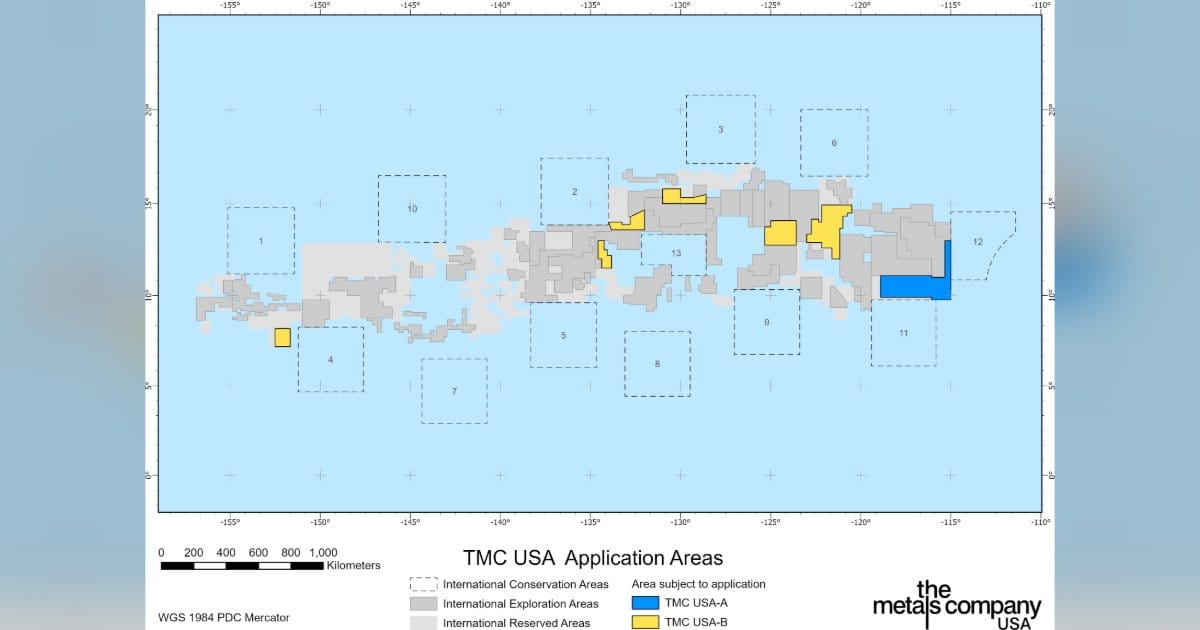
Publication of the consolidated application in the Federal Register follows the determination of full compliance by NOAA on April 28, 2026, and provides public notice of TMC USA’s submission. NOAA’s review will continue under DSHMRA and its implementing regulations and is now expected to proceed through remaining steps, including:
- Certifying the application
- Conducting the required environmental review and providing a draft Environmental Impact Statement for public comment
- Making a final determination on whether to issue the exploration license and commercial recovery permit and associated Terms, Conditions, and Restrictions
Gerard Barron, Chairman and CEO of The Metals Company, said: “Publication of our consolidated application in the Federal Register is an important milestone on the permitting path under DSHMRA as it starts the clock on the public comment period that NOAA views as a prerequisite to certification. Every step toward a final regulatory decision brings us closer to potential commercial production and to a future in which the United States has greater mineral sovereignty in several critical minerals. Our confidence in the permitting process remains high, and we continue to advance our first project toward commercial production in parallel with NOAA’s permitting process.”
Earlier this year, TMC USA submitted a consolidated application for an exploration license and a commercial recovery permit for polymetallic nodules in the TMC USA-A area in international waters of the Clarion Clipperton Zone (CCZ) in the Pacific Ocean. The application was filed under NOAA’s new consolidated application and review process and represents the first submission of its kind. It covers a ~65,000 km2 exploration and commercial recovery area, with an estimated resource of 619 Mt of wet nodules and potential exploration upside of an additional 200 Mt.
TMC USA’s application draws on one of the most comprehensive datasets ever assembled on polymetallic nodules and their surrounding ecosystems, informed by more than a decade of environmental baseline studies, scientific research and offshore engineering.
In addition to the USA-A consolidated application, TMC USA is also advancing an application for an exploration license over the USA-B area. On August 17, NOAA published a Notice of Intent to prepare an Environmental Impact Statement for the USA-B application in the Federal Register, following its earlier certification of the application on May 26, 2026. The USA-B application area covers ~122,000 km2 of seafloor containing an estimated 1.02 billion tonnes of polymetallic nodules with high grades of nickel, cobalt, copper, and manganese, and several rare earth elements.
NOAA has played a central role in advancing scientific understanding of deep seabed mining impacts since the 1970s, including conducting environmental research cruises in the CCZ, monitoring early nodule collection trials, and publishing a Programmatic Environmental Impact Statement covering the CCZ in 1981. In the 1980s and 1990s, NOAA conducted further research into benthic plumes through its Benthic Impact Experiments program, where the agency used a custom-built machine to simulate and study seafloor disturbance. The agency issued comprehensive DSHMRA implementing regulations in 1981 (for exploration licenses) and 1989 (for commercial recovery permits) and has maintained an active licensing program since that time, with multiple exploration licenses renewed on a five-year basis.