
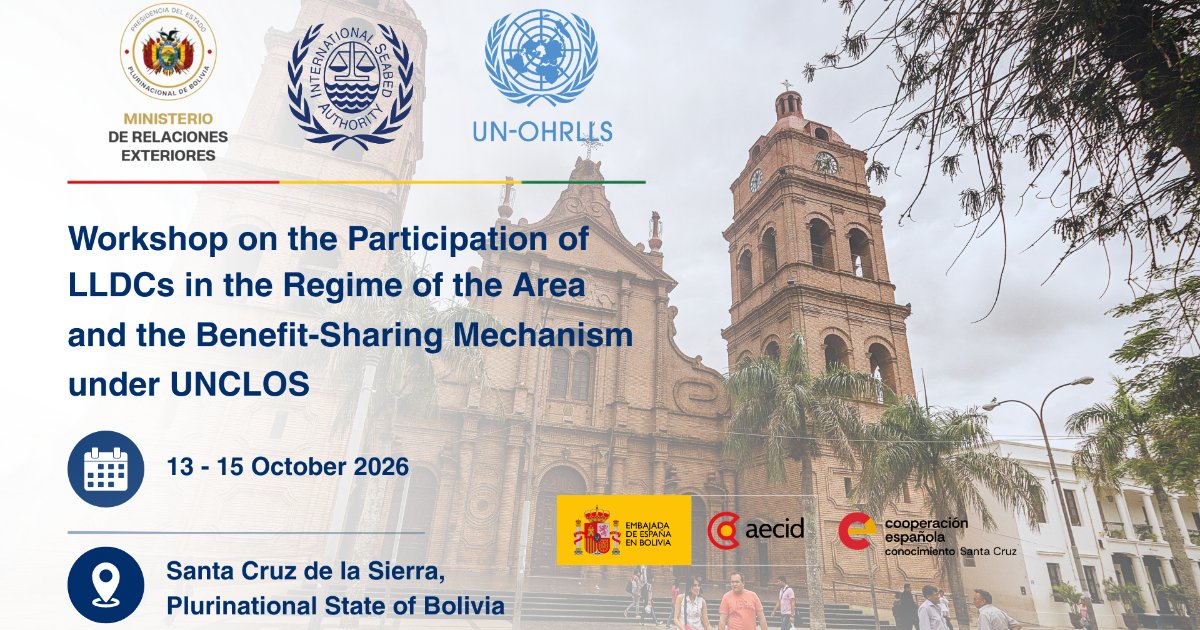
The workshop is organized by the International Seabed Authority (ISA), in partnership with the Government of the Plurinational State of Bolivia, in its capacity as Chair of the Group of Landlocked Developing Countries, and the United Nations Office of the High Representative for the Least Developed Countries, Landlocked Developing Countries and Small Island Developing States.
The opening session will be attended by H.E. Mr. Héctor Huanca, Minister of Foreign Affairs of the Plurinational State of Bolivia; Madam Secretary-General of the International Seabed Authority, Leticia Carvalho; and H.E. Mr. Fernando García Casas, Ambassador of Spain to the Plurinational State of Bolivia.
The meeting comes at a critical moment for international ocean governance. ISA Member States are advancing discussions on the rules, regulations and procedures for future activities in the international seabed area, including the financial model and benefit-sharing mechanism, as well as the standards and guidelines that will safeguard the marine environment from future activities. For landlocked developing countries, these discussions are not remote. UNCLOS expressly recognizes their interests and needs, and the principle of the common heritage of humankind requires that benefits from the Area be shared for the benefit of all, irrespective of geographical location.
The workshop is expected to bring together representatives from 18 landlocked developing countries from Africa, Asia, and Latin America, together with members of the Finance Committee of the International Seabed Authority and experts in international law, mineral governance, benefit-sharing, marine science, and capacity development. Participants will also include representatives of regional and institutional partners, including the African Union Scientific, Technical and Research Commission, as well as experts from sponsoring States with experience in the implementation of the regime of the Area.
Over three days, participants will examine the rights and opportunities available to landlocked developing countries under UNCLOS, including participation in the regime of the Area, access to knowledge and training, scientific cooperation, technology transfer, and future benefit-sharing.
“Landlocked developing countries have a direct stake in the future of ocean governance,” said Madam Secretary-General Leticia Carvalho. “The principle of the common heritage of humankind must be meaningful for every country, irrespective of geography. This workshop is an opportunity to support greater understanding, stronger participation and more practical cooperation with landlocked developing countries under UNCLOS.”
Minister of Foreign Affairs Héctor Huanca underscored the importance of securing the maritime rights of landlocked countries under international law and called for concerted action to remove the structural barriers that hold back their development.
The workshop also supports the implementation of the Awaza Programme of Action 2024–2034 by helping identify practical ways for landlocked developing countries to participate more actively in international ocean governance.
The event will take place at the Centro de Formación de la Cooperación Española in Santa Cruz de la Sierra, with the support of the Government of Spain through AECID.