
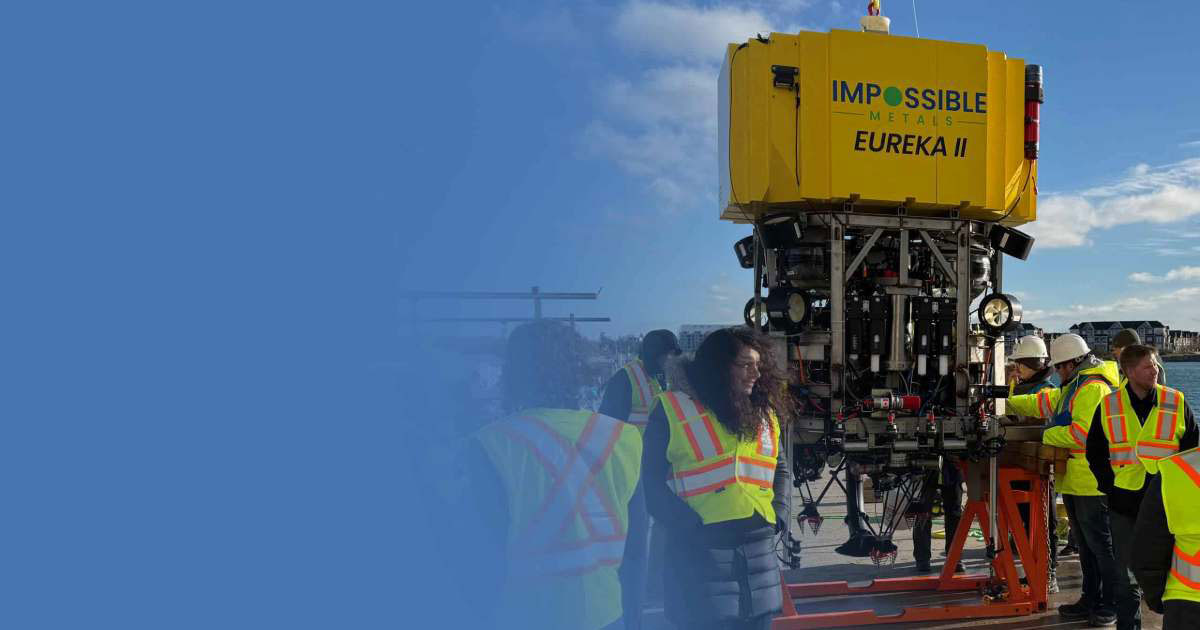
The MOU establishes a framework for collaboration between Deep Sea Minerals and Impossible Metals with respect to the potential deployment and evaluation of Impossible Metals’ autonomous, riserless robotic collection technology within Deep Sea Minerals’ prospective exploration license areas, if and as such licenses are awarded. The contemplated areas of cooperation include technology deployment, test mining, environmental monitoring, pilot production planning, commercial-scale harvesting evaluation, and potential downstream supply chain opportunities.
Impossible Metals’ Eureka Collection System is designed to use buoyancy control, computer vision, and robotic arms to selectively collect polymetallic nodules from the seafloor. The technology is intended to provide a lower-disturbance alternative to other seafloor collection methods by targeting individual nodules, preserving habitat, avoiding sea life, and reducing sediment disturbance.
“Deep Sea Minerals is pursuing a responsible, staged and partnership-driven approach to offshore critical minerals development,” said James Deckelman, Chief Executive Officer of Deep Sea Minerals Corp. “Impossible Metals has developed a differentiated technology platform that aligns with our objective of evaluating lower-impact approaches to polymetallic nodule exploration and potential future collection. This MOU gives us a practical framework to assess how autonomous robotic collection technology could support our long-term development plans as we continue to advance through the applicable regulatory processes.”
“This collaboration reflects a larger shift underway in how the world thinks about critical resources. As global demand accelerates for the minerals that power defense systems, advanced manufacturing, and energy infrastructure, the question is no longer whether new supply is needed, but how it can be accessed responsibly,” said Steve Curnutte, Executive Chairman of Impossible Metals Inc. “Impossible Metals was built on the belief that breakthroughs in robotics, autonomy, and machine intelligence can fundamentally improve that equation. Together with Deep Sea Minerals, we are advancing a future where selective collection enables both economic progress and responsible stewardship of the deep ocean.”
Deep Sea Minerals, through its US subsidiary American Deep Sea Minerals Corp., has submitted an exploration license applicable to the National Oceanic and Atmospheric Administration (NOAA) under the Deep Seabed Hard Mineral Resources Act of 1980. The application remains under NOAA review, and no exploration license has been awarded. The Company has also established Deep Sea Minerals Cook Islands Limited to support engagement with the Cook Islands Seabed Minerals Authority in connection with a potential exploration license application, which has not yet been filed.
The MOU is non-binding and does not create any obligation for either party to proceed with test mining, pilot production, commercial production or any binding commercial arrangement. Any such arrangement would be subject to the negotiation and execution of one or more definitive agreements.