

The application was filed under NOAA’s new consolidated application and review process and represents the first submission of its kind. It covers a ~65,000 km2 exploration and commercial recovery area in the CCZ, compared to a commercial recovery area of ~25,000 km2 in TMC USA’s initial commercial recovery permit application from April 2025.
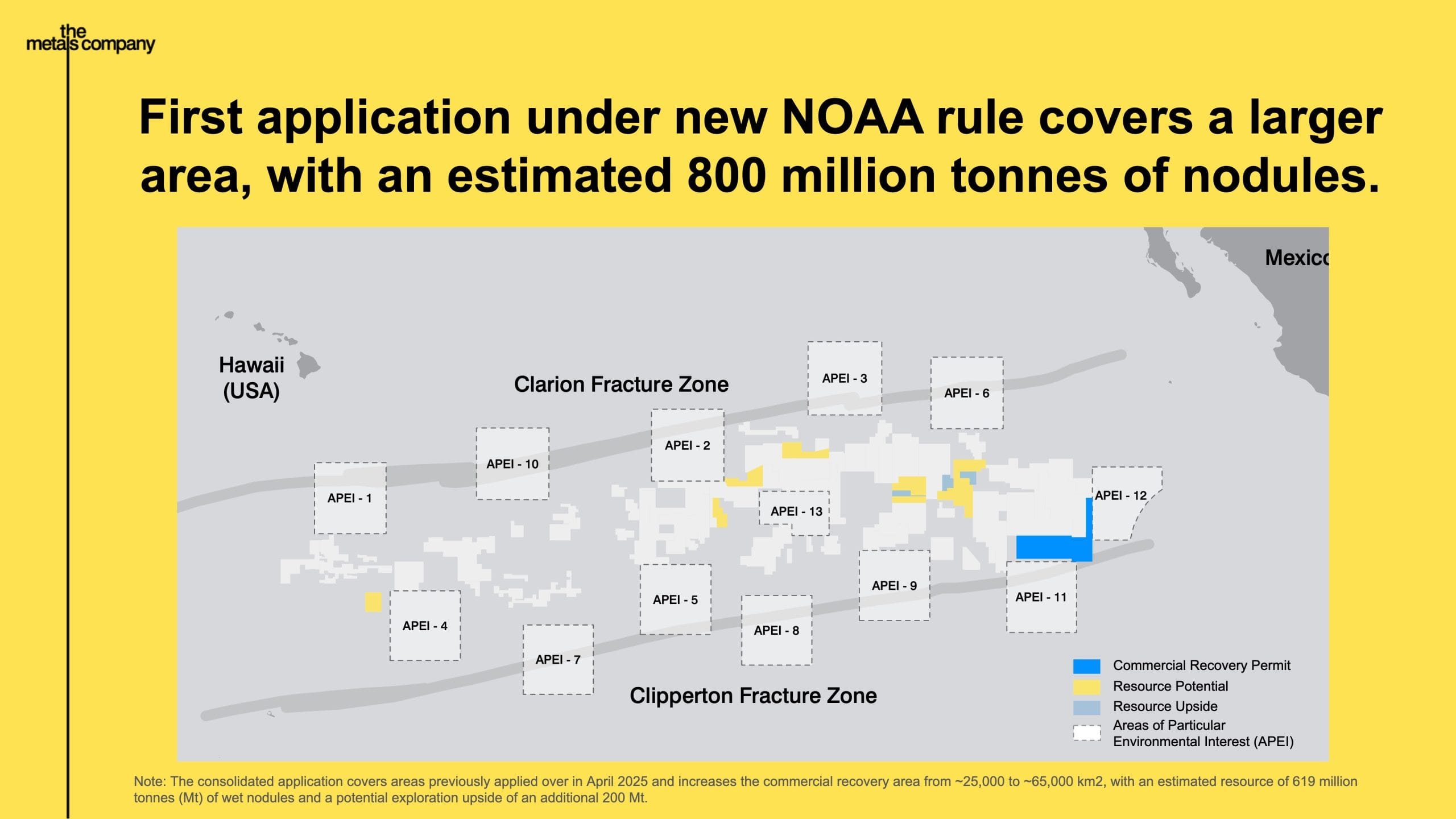
Gerard Barron, Chairman and CEO of TMC, commented: “This new application represents the culmination of more than a decade of disciplined scientific, engineering, and environmental work. It translates years of exploration, testing, and data collection into a single, comprehensive submission for a defined, expanded, and game-changing critical minerals project, with more than 800 million estimated tonnes of nodules containing high-grade nickel, copper, cobalt, and manganese—representing a metal grade of approximately 3.2% for nickel equivalent and 7% copper equivalent. We believe it demonstrates both the maturity of our project and our readiness to proceed to commercial operations under the US regulatory framework.”
He added: “I want to commend the US Administration for its recognition of critical minerals as a matter of national security and that offshore minerals are a key part of the solution.”
The increase in the proposed commercial recovery area is supported by extensive prior work, including multi-year environmental baseline studies, resource assessments, engineering development, and offshore test mining. The application incorporates data and analyses generated through 27 offshore resource and environmental research cruises (across both NORI-D and TOML-F and inclusive of all phases of the post-test mining sampling program), thousands of seafloor samples, and the largest integrated test mining campaign conducted in the deep sea since US-based consortia first tested technologies in the CCZ in the 1970s.
Supported by newly published, peer-reviewed research by independent academics drawing on the Company’s test mining and recovery data—demonstrating that both biodiversity and sediment plume impacts are confined to the directly mined area—TMC is confident that its dataset provides a robust, scientifically grounded basis to commence and responsibly scale its commercial operations.
The application outlines a careful phased development approach, beginning with commercial recovery activities in a portion of the license area where nodules and habitats have been extensively characterized and where test mining and monitoring have already been completed. These prior activities include the successful collection of 3,000 tonnes of polymetallic nodules using a fully-integrated system, comprehensive environmental monitoring from the seafloor to the ocean surface, and pilot- and commercial-scale processing tests demonstrating the conversion of nodules into battery and steelmaking feedstocks.
NOAA has played a central role in advancing scientific understanding of deep seabed mining impacts since the 1970s, including conducting environmental research cruises in the Clarion Clipperton Zone (CCZ), monitoring early nodule collection trials, and publishing a Programmatic Environmental Impact Statement covering the CCZ in 1981. The agency issued comprehensive DSHMRA implementing regulations in 1981 (exploration licenses) and 1989 (commercial recovery permits) and has maintained an active licensing program since that time, with multiple exploration licenses renewed on a five-year basis. The newly effective rule updates this regulatory framework to reflect decades of additional environmental research, data collection, and technological development.
Since its founding, the Company has delivered many of the nodule industry’s firsts, uniquely positioning TMC USA to pursue commercial recovery activities expeditiously in accordance with the new NOAA rule.
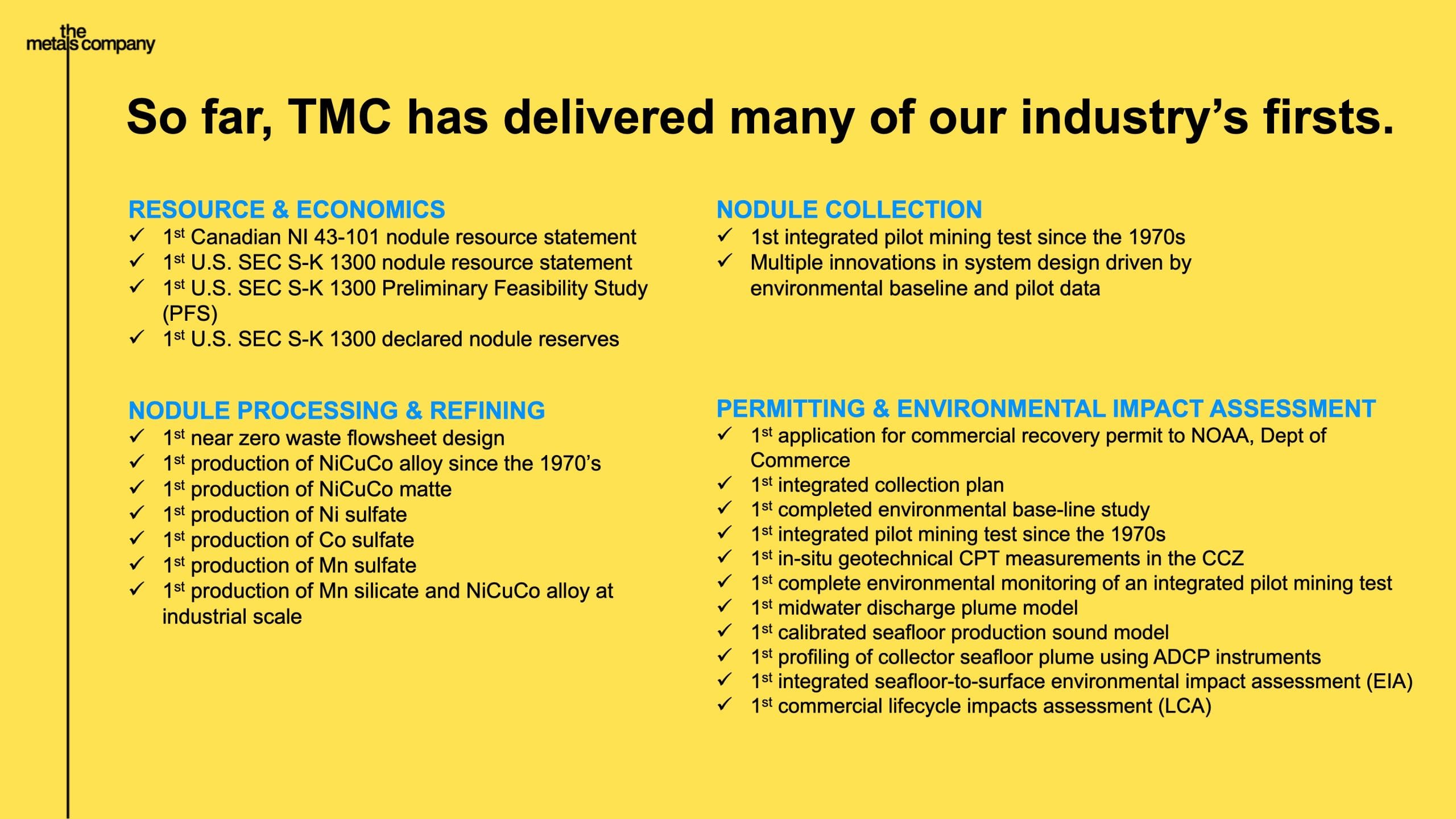
Resource & Economics
- 1st Canadian NI 43-101 nodule resource statement
- 1st US SEC S-K 1300 nodule resource statement
- 1st US SEC S-K 1300 Preliminary Feasibility Study (PFS)
- 1st US SEC S-K 1300 declared nodule reserves
Nodule Collection
- 1st integrated pilot mining test since the 1970s
- Multiple innovations in system design informed by environmental baseline and pilot data
Nodule Processing & Refining
- 1st near zero-solid-waste flowsheet design
- 1st production of NiCuCo alloy since the 1970s
- 1st production of NiCuCo matte
- 1st production of Ni sulfate
- 1st production of Co sulfate
- 1st production of Mn sulfate
- 1st production of Mn silicate and NiCuCo alloy at industrial scale
Permitting & Environmental Impact Assessment
- 1st application for commercial recovery permit to NOAA
- 1st integrated collection plan
- 1st completed environmental baseline study
- 1st integrated pilot mining test since the 1970s
- 1st in-situ geotechnical CPT measurements in the CCZ
- 1st complete environmental monitoring as part of an integrated pilot mining test
- 1st midwater discharge plume model
- 1st calibrated seafloor production sound model
- 1st profiling of collector seafloor plume using ADCP instruments
- 1st integrated seafloor-to-surface environmental impacts assessment (EIA)
- 1st commercial lifecycle impacts assessment (LCA)