
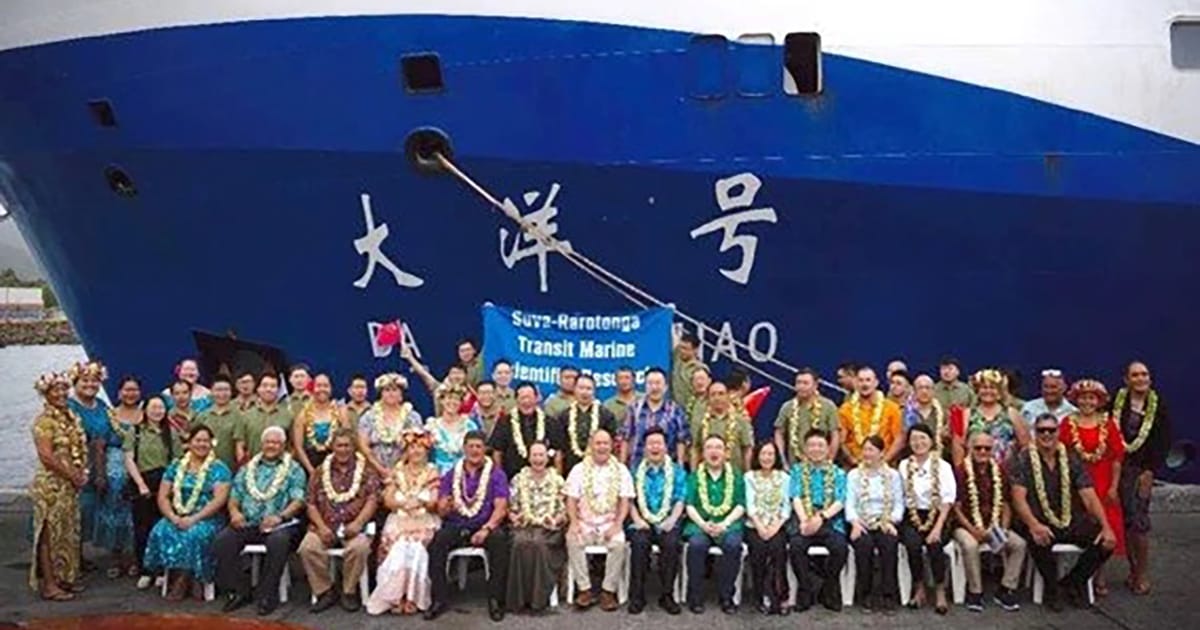
The Cook Islands delegation included Edward Herman, Dr. John Parianos, Rima Browne, and Tanga Morris Jr. from the Seabed Minerals Authority (SBMA), together with representatives from the House of Ariki, National Environment Services (NES), and Te Ipukarea Society (TIS): Philip Vakatini Ariki, Troy Penno, and Alanna Smith.
“Our approach was simple—learn by doing,” said Edward Herman, SBMA Partnerships & Cooperation Director. “Every activity deepened our understanding of our Marae Moana.”
As Head of Delegation, SBMA Senior Knowledge Management Officer Rima Browne emphasized the importance of building national capabilities through real-time learning. “Being on board the vessel as part of the science team helped strengthen both our knowledge and our relationship. Partnership and collaboration are what build long-term capability for the Cook Islands.”
Scientific Work and Key Highlights
- Mapping the Deep: In the Acoustic Lab, Dr. John Parianos and Chief Scientist Professor Li demonstrated high-resolution sonar systems used to map seafloor structures and deep-ocean geology.
- Understanding Ocean Change: Working with geologist Wei Yan, the team deployed an environmental mooring that will collect long-term current and temperature data. It will be retrieved next year, providing rare continuous information for the Cook Islands.
- Sampling Ocean Waters: Observers Troy Penno and Yang Long collected deep-ocean water samples to analyze chemistry, nutrients, and baseline environmental conditions.
- Sampling the Seafloor: Tanga Morris from SBMA and scientist Lu Bo used a box corer to retrieve sediment samples from depths of 5,000 to 6,000 meters below the surface, essential for understanding deep-sea habitats and seafloor processes.
- Life in the Deep: Independent observer Alanna Smith supported eDNA and EK80 acoustic data collection to help identify species living far below visible light. Her message: “We can’t protect what we don’t understand.”
- Turning Observations into Data: Oceanographer Jie Li led the processing of chemical, geological, biological, and geophysical datasets. All data has now been transferred to the Cook Islands Government and will be made publicly accessible through SBMA’s data repository.
- Life at Sea: Beyond the science, Cook Islands delegates and the Da Yang Hao crew shared meals and cultural exchanges, building friendships and strengthening scientific collaboration.
“Collaborating with our international partners is a key part of our work, and this cruise is one of them,” Herman added.
To help the community follow this journey, SBMA produced a short Facebook mini-series filmed on board the R/V Da Yang Hao. The videos take viewers inside the labs, show how samples are collected, and share the experiences of the team at sea.
To watch the “At-Sea’ Mini-Series on the R/V Da Yang Hao, visit: https://www.facebook.com/reel/1509419936775842