
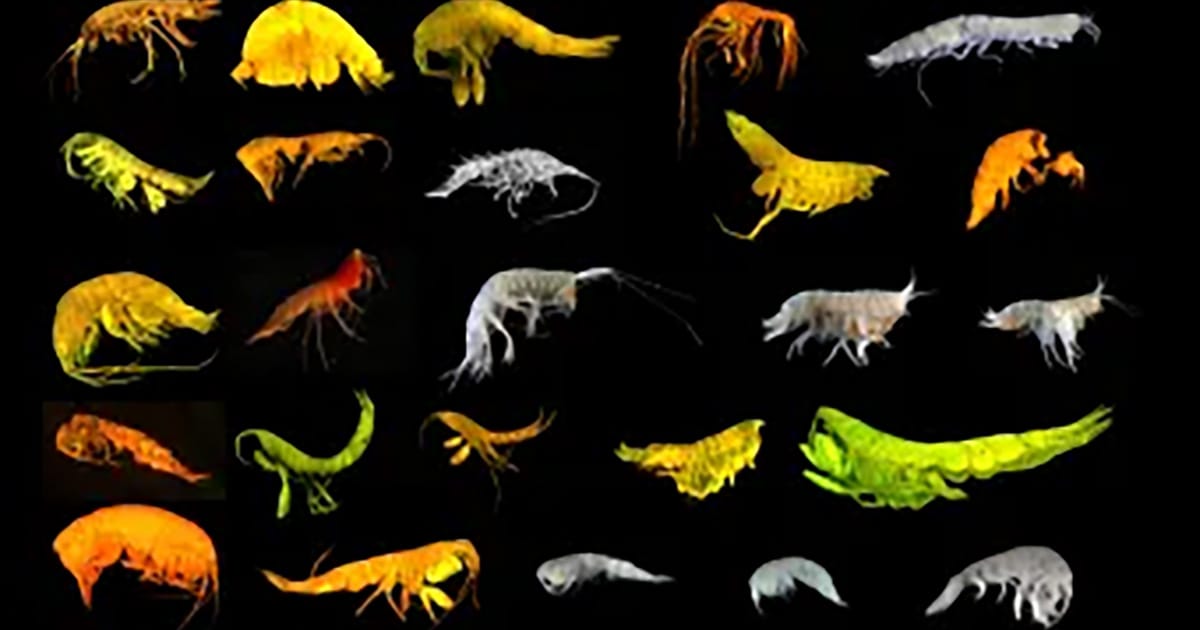
The discoveries, which have been published as part of a new open-access ZooKeys special issue, mark a significant advance in identifying the biodiversity of the CCZ—an area which spans six million square kilometers between Hawai’i and Mexico.
Led by Dr. Anna Jażdżewska, University of Lodz (UL), and Dr. Tammy Horton, National Oceanography Centre (NOC), 16 experts and early-career scientists came together for a week-long taxonomy workshop dedicated to describing new amphipod species from the CCZ, which was organized at the Department of Invertebrate Zoology and Hydrobiology, Faculty of Biology and Environmental Protection, UL in 2024.
Their findings form part of the International Seabed Authority’s Sustainable Seabed Knowledge Initiative (SSKI) and its ‘One Thousand Reasons’ project, which aims to describe 1,000 new species by the end of the decade.
The research revealed a number of firsts for science, with 24 newly described species spanning 10 amphipod families, including predators and scavengers.
Notable discoveries include:
- A new family (Mirabestiidae) and superfamily (Mirabestioidea), revealing completely new evolutionary branches.
- Two new genera (Mirabestia and Pseudolepechinella).
- Deepest-known records for multiple genera.
- First molecular barcodes for rare species
Dr. Tammy Horton said: “To find a new superfamily is incredibly exciting, and very rarely happens, so this is a discovery we will all remember.
“With more than 90% of species in the CCZ still unnamed, each species described is a vital step towards improving our understanding of this fascinating ecosystem.
“Describing the species encountered during these studies is a critical step in documenting the rich biodiversity of the CCZ, enabling us to communicate effectively about the fauna.”
The team of researchers from research institutions from across the world, pictured together at the University of Lodz. (Image credit: University of Lodz)
A Global Collaboration
Taxonomy is vital to understanding the fauna of the CCZ, providing fundamental knowledge of species, their distributions, and how each species contributes to the fragile ecosystem.
Eight of the species were identified and described by researchers from NOC, who joined colleagues from around the globe including institutions, such as University of Lodz, Natural History Museum, London, Canadian Museum of Nature, Earth Sciences New Zealand (NIWA), University of Hamburg, Senckenberg – Leibniz Institution for Biodiversity and Earth System Research (SGN) and University Museum of Bergen.
The collaborative project also demonstrated the effectiveness of running coordinated and focused taxonomic workshops, providing a model way of working for the future.
Dr. Anna Jażdżewska said: “This was a truly collaborative process that allowed us to achieve the ambitious goal of describing more than 20 species new to science within a year—something that would not have been possible if each of us worked independently.
“The team’s findings provide information that is crucial for future conservation and policy decisions, and it highlights how important it is for this work to continue.”
Through initiatives such as these, describing around 25 species per year, the amphipods in the eastern CCZ could be almost completely known within 10 years.
What’s in a Name?
New species must each be named, and that honor falls to the research team, who often draw inspiration from those around them.
Many of the 24 new species have been given meaningful names by those who have spent time learning about them and describing them.
Co-leads Dr. Tammy Horton and Dr. Anna Jażdżewska both saw species named for them, Byblis hortonae, Thrombasia ania, and Byblisoides jazdzewskae (respectively).
Dr. Horton named one of the species in the new superfamily (Mirabestia maisie) after her daughter, who has waited several years to join her siblings in having that unusual honor.
There was an opportunity to pay tribute to the World Register of Marine Species (WoRMS), with Eperopeus vermiculatus being given the name in recognition of WoRMS, which researchers described as providing a ‘wonderful resource for all marine taxonomists.’
Involving early‑career scientists (including students) also allowed them to leave their mark in the species names, by commemorating their relatives and by creating intriguing links between the deep sea and the virtual world. According to the author, one species, Lepidepecreum myla, resembles Myla (a character from a video game), as both are just little arthropods trying to survive in total darkness.’
The team also drew inspiration from linguistics for one species, with Pseudolepechinella apricity representing the spirit of warmth and friendship that came from the week-long workshop.
Dr. Horton revealed: “Apricity means the feeling of the warmth of the winter sun, and it is one of my favorite words. It was very apt to use during the workshop as we discussed our findings in the warmth of the February sun amid the snow of the Polish winter in Lodz. It was certainly fitting to also use it for one of our amphipod discoveries.
“We came together as research colleagues, but the spirit of collaboration and shared experience shone through, so it was important to recognize that in our work.”