
So what happens to the filter-feeding organisms that live in and around mining areas?
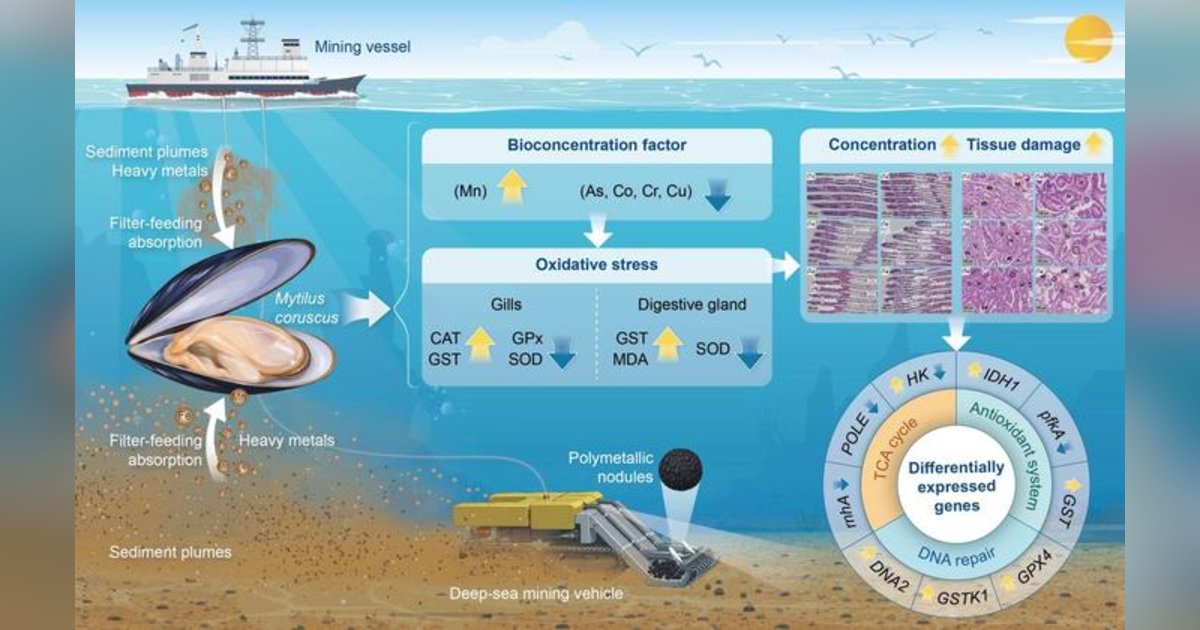
In a new study published in Water & Ecology, a research team led by Yonggang Jia from Ocean University of China simulated the heavy metal exposure conditions resulting from nodule mining, using polymetallic nodules and sediments collected at 5,365 m depth in the Clarion-Clipperton Zone (CCZ) of the eastern Pacific Ocean and the thick-shell mussel (Mytilus coruscus) as the model organism.
The research team found that shaking disturbance released heavy metals into seawater at concentrations 1.8–11.6 times higher than controls. “After 96 hours of acute exposure, mussels exhibited selective metal accumulation: bioconcentration factors for Mn increased by up to 2.8-fold in high-concentration groups, whereas those for Cu, Co, chromium (Cr), and arsenic (As) declined by 47–89 percent, suggesting that high exposure loads saturate or inhibit uptake mechanisms for most metals,” explained Jia.
Notably, oxidative stress responses proved strongly tissue-specific. “The gills responded rapidly, with antioxidant enzyme activities surging within 12–24 hours of exposure, whereas the digestive gland suffered progressively severe lipid peroxidation, with malondialdehyde levels reaching up to 6.1 times the control level at 96 hours,” Jia shared.
Meanwhile, histopathological examination confirmed concentration-dependent damage: gills showed epithelial cell adhesion, hemolymph sac erosion, and ciliary disruption, while digestive glands exhibited digestive tubule atrophy and blood cell aggregation, with lesions most severe in high-concentration groups.
By conducting gene expression analysis, the researchers further uncovered divergent molecular strategies between the two tissues. In particular, gills upregulated genes related to antioxidant activity, energy metabolism, and DNA repair—such as GST, HK, IDH1, and DNA2—to mount a rapid defense. In contrast, the digestive gland downregulated key genes involved in energy metabolism and DNA repair (HK, pfkA, rnhA, POLE), exacerbating tissue damage over time.
“Our findings demonstrate that heavy metals released from nodule-bearing sediments impose acute, tissue-specific toxicity on filter-feeding bivalves,” said Jia. “The gills respond quickly as a barrier organ—making it a critical target for biological monitoring, but the digestive gland accumulates damage over time.”
The researchers encouraged future work to focus on simulating deep-sea conditions of low temperature and high pressure, and possibly expanding to other representative organisms such as echinoderms, and validating the results through on-site investigations in nodule areas.